
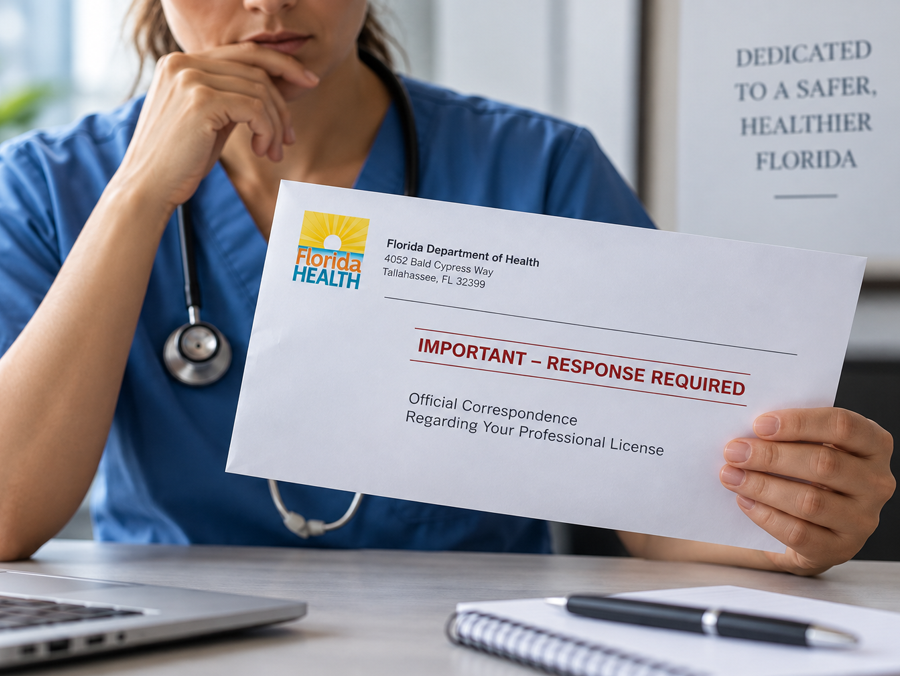

Receiving a letter from the Florida Department of Health (“DOH” or “Department”) notifying you that a complaint has been filed against your professional license can be alarming. The existence of an investigation, however, does not mean that you have violated Florida law or that disciplinary action will necessarily be taken against your license.
However, it does mean that a regulatory process has begun in which decisions made during the investigation may affect whether the matter is dismissed or proceeds to formal prosecution.
Florida physicians, nurses, pharmacists, dentists, and other licensed healthcare professionals should therefore take a DOH investigation seriously from the outset. Among the first issues to consider are the deadline to respond, the allegations being investigated, the records and evidence relevant to those allegations, and whether submitting a written response is appropriate.
Why Did I Receive a DOH Investigation Letter?
The DOH is responsible for investigating complaints involving healthcare professionals regulated by the Department and their respective professional boards.
Under section 456.073, Florida Statutes, the Department generally must investigate a complaint that is written, signed, and “legally sufficient.” A complaint is legally sufficient when it alleges ultimate facts showing that a violation of Chapter 456, the applicable professional practice act, or a rule adopted by the Department or applicable licensing board has occurred.
This requirement is important. The mere fact that someone is dissatisfied with a healthcare professional does not necessarily establish a violation of Florida’s licensing laws. The allegations must provide a legally sufficient basis for the Department to investigate.
The Department may also initiate an investigation when it has reasonable cause to believe that a licensee has violated a Florida statute or a rule of the Department or applicable professional board.
The Investigation Is Not a Finding of Guilt
A DOH investigation should be distinguished from an Administrative Complaint.
At the investigative stage, the Department is gathering and evaluating information to determine whether there is sufficient evidence to proceed against the healthcare professional’s license. No determination of probable cause has necessarily been made simply because the practitioner receives an investigative letter.
The Department’s Investigative Services Unit may obtain medical records and other documents, interview the complainant, patient, practitioner, and other witnesses, and issue subpoenas for information. Once the investigation is completed, an investigative report is prepared and forwarded for legal review.
The Department’s attorneys then evaluate the investigative materials and may recommend various outcomes, including closure of the investigation, further review, an emergency order in appropriate circumstances, or presentation of the matter for a probable cause determination.
Pay Close Attention to the 20-Day Response Period
One of the most important provisions of Florida’s professional licensing law appears in section 456.073(1), Florida Statutes.
Except in certain circumstances specified by statute, when the Department undertakes an investigation, it must promptly provide the healthcare professional or the professional’s attorney with a copy of the complaint or other document that initiated the investigation.
The healthcare professional may submit a written response to the allegations within 20 days after service of the complaint or initiating document. Importantly, the statute also provides that the written response shall be considered by the probable cause panel. This creates an important opportunity — but also an important strategic decision.
Should I Respond to the DOH Complaint?
There is no universal answer or bright line rule to this question. A well-prepared response can potentially identify factual inaccuracies, supply records that place the allegations in context, demonstrate that the alleged conduct does not constitute a statutory or regulatory violation, address deficiencies in the complaint, or otherwise provide the Department with reasons why formal prosecution is unwarranted. The response may ultimately become part of the materials considered in determining whether probable cause exists. But a response should not be treated as an informal opportunity to “tell your side of the story.”
Statements made during the investigative process may become significant if the case later results in an Administrative Complaint. A response prepared without considering the potential legal issues may unnecessarily admit facts, create inconsistencies, raise issues beyond those contained in the original complaint, or provide information that could later be used in the prosecution of the case. For that reason, the decision whether to respond — and what the response should say — should be made after evaluating the allegations, applicable statutes and rules, and available evidence.
Do Not Assume the Investigator Is Your Advocate
Healthcare professionals are accustomed to explaining medical and professional decisions. When contacted by an investigator, the natural reaction may therefore be to immediately explain what happened. That approach deserves careful consideration. DOH investigators perform an investigative function. According to the Department, investigators may interview the subject of the complaint and other witnesses, collect documents and evidence, serve subpoenas and official orders, and prepare an investigative report that is ultimately provided to the Department’s attorneys. An investigator’s request for information should therefore be evaluated in the context of an active regulatory investigation. However, before providing a substantive statement or participating in an interview, a licensee should understand the allegations being investigated and the potential licensing consequences.
Preserve and Review the Relevant Records
Upon receiving notice of an investigation, identify and preserve potentially relevant evidence. Depending upon the nature of the complaint, that could include patient records, prescriptions, billing records, correspondence, emails, text messages, office policies, credentialing records, photographs, employment records, continuing-education documentation, or other materials concerning the allegations. Preserving records is different from immediately producing every potentially relevant document to an investigator. The scope of any request or subpoena should be reviewed independently.
The records should also be evaluated against the allegations before a response is prepared. In many professional licensing matters, contemporaneous documentation can be critical to determining whether the allegations are factually supported.
Determine What Law or Rule the Allegations Actually Implicate
A licensing investigation is ultimately about whether conduct violates a statute or administrative rule, not merely whether someone disagrees with a healthcare professional’s actions. Chapter 456 contains grounds for discipline applicable to healthcare professionals generally. Each profession also has its own practice act and administrative rules establishing additional standards and potential disciplinary violations. For example, an investigation may concern allegations involving standard of care, recordkeeping, prescribing, criminal conduct, fraud or misrepresentation, impairment, patient boundaries, reporting obligations, or another profession-specific requirement. An effective evaluation therefore goes beyond asking, “Did this happen?” The additional question is: Even assuming the alleged facts are true, do those facts constitute a violation of the statute or rule under which discipline may be imposed? That distinction can be important when evaluating the legal sufficiency and merits of a complaint.
What Happens During the Investigation?
The precise investigative steps depend upon the allegations. The Department states that its investigators may obtain records and other evidence, interview the complainant, patient, practitioner and witnesses, and issue subpoenas. The investigator then prepares a report for review by the Department’s attorneys.
Section 456.073 reflects a legislative intent that the Department complete its initial investigative findings and recommendations concerning probable cause within six months after receiving the complaint. The statute also provides, however, that failure to comply with statutory investigative time limits generally constitutes harmless error unless the fairness of the proceeding or correctness of the action may have been impaired by a material procedural error. The practical lesson is that an investigation may take time, and the expiration of six months does not automatically mean that the case has been dismissed.
Can I Obtain the DOH Investigative File?
At a later stage of the investigation, an important additional right arises. Under section 456.073(10)(c), once the investigation has been completed and the Department has recommended a finding of probable cause, the practitioner or the practitioner’s attorney may make a written request to inspect the investigative file or obtain a copy at the practitioner’s expense. Subject to the statutory confidentiality requirements, this may include expert reports and patient records connected with the investigation.
The practitioner may then submit a written response to information contained in the investigative file. That response generally must be filed within 20 days after the Department mails the investigative materials unless an extension is granted. This can provide another important opportunity to address the evidentiary record before a probable cause determination.
What Is the Probable Cause Panel?
After the investigation is completed, the Department generally submits its investigative report and recommendation to the probable cause panel of the appropriate professional board. The probable cause panel determines whether there is probable cause to believe that a violation occurred. The practitioner’s written response is among the materials that must be considered by the panel. If probable cause is not established, the matter may be closed. The panel may also issue a letter of guidance in lieu of finding probable cause where permitted by law. In contrast, if probable cause is found, the panel generally directs the Department to file a formal Administrative Complaint against the licensee. The case then proceeds under Florida’s Administrative Procedure Act, Chapter 120, Florida Statutes. A formal hearing before an Administrative Law Judge may be available when there are disputed issues of material fact.
Is the DOH Investigation Public?
Generally, not during the initial investigative stage. Section 456.073(10), Florida Statutes, provides that the complaint and information obtained during the Department’s investigation are confidential and exempt from Florida’s public-record requirements until 10 days after probable cause is found, unless the practitioner waives confidentiality earlier. If probable cause is not found, the Department states that the case remains confidential. This confidentiality can be particularly important to professionals concerned about their reputation, employment, credentialing, patients, or business relationships.
What If the Person Who Filed the Complaint Withdraws It?
Withdrawal of the complaint does not necessarily end the investigation. Section 456.073 expressly authorizes the Department to continue investigating—and the Department or applicable board to take appropriate final action—even when the original complainant withdraws the complaint or indicates that he or she no longer wants the matter prosecuted. Once the regulatory process has begun, the complainant does not necessarily control whether it continues.
Can DOH Investigate an Anonymous Complaint?
Under certain circumstances, yes. Florida law permits the Department to investigate an anonymous complaint when it is written and legally sufficient, the alleged violation is substantial, and the Department has reason to believe after a preliminary inquiry that the alleged violation is true. Accordingly, the absence of an identified complainant does not automatically require dismissal of a licensing investigation.
What Should I Do After Receiving a DOH Investigation Letter?
- Read the entire notice and complaint. Identify exactly what the Department says it is investigating.
- Calendar every deadline. In many DOH investigations, the initial written-response period is 20 days after service.
- Preserve relevant evidence. Identify records, communications, and other documents that may relate to the allegations.
- Avoid an impulsive response. Do not assume that immediately explaining the situation to the investigator is necessarily the best approach.
- Identify the statutes and rules potentially at issue. The allegations should be evaluated against the actual elements of the claimed licensing violation.
- Consider the consequences beyond the immediate investigation. Depending upon the profession and circumstances, discipline may have implications for employment, credentialing, hospital privileges, participation in insurance programs, other state licenses, or interstate practice privileges.
- Consider obtaining legal advice early in the process. The investigative stage may provide an opportunity to address allegations before an Administrative Complaint is filed.
The Goal Is to Address the Case Before It Becomes a Disciplinary Case
A professional license may represent years of education, training, and work. For that reason, a DOH investigation should not be viewed as ordinary correspondence or simply an administrative inconvenience. The investigation is also an important opportunity. The fact that a complaint has been opened does not mean that probable cause will be found. Florida law expressly permits the Department to dismiss a case, or portions of a case, when there is insufficient evidence to support prosecution. A carefully evaluated response may therefore focus not simply on defending against eventual discipline, but on whether the evidence and law support prosecution in the first place.
Fischer Law represents Florida healthcare professionals in Department of Health investigations and professional licensing matters, including matters involving physicians, nurses, pharmacists, and other licensed professionals. If you have received notice of a DOH investigation or complaint and would like to discuss the allegations, contact Fischer Law to schedule a consultation.
This article is for informational purposes only and does not constitute legal advice. The application of Florida licensing law depends upon the particular profession, allegations, and circumstances involved.